
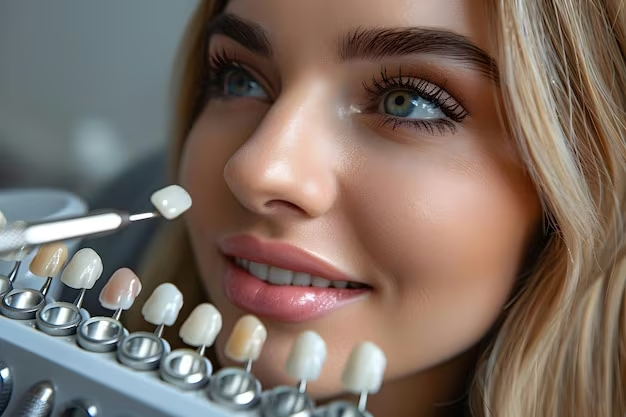
Veneers and crowns can both upgrade a smile, but the better option depends on what your tooth actually needs: veneers are a cosmetic shell for the front of a healthy tooth, while crowns cap and protect a tooth that is damaged or weakened. At Sola Dental Spa in Staten Island, New York, Dr. Anne Gershkowitz helps patients choose between veneers and crowns by looking at how much tooth structure is left, the goal for the smile, and long-term durability. If budget is part of your decision, our guide on how much dental veneers cost is a helpful starting point.
Choose a veneer when the tooth is basically healthy and the goal is cosmetic: closing a small gap, hiding a stain, or reshaping the front surface. Choose a crown when the tooth is cracked, heavily filled, root-canaled, or structurally weak and needs full coverage to stay protected.
“I think of it this way: a veneer dresses up a tooth, a crown rebuilds and shields one. When most of the natural tooth is sound, I lean toward the more conservative veneer because we remove less enamel. When a tooth is compromised, a crown is the safer long-term choice because it wraps the whole tooth.”
Dr. Anne Gershkowitz, DDS, Founder, Sola Dental Spa
A patient recently came in unhappy with two front teeth: one had a stubborn stain and a tiny chip, the other had a large old filling that kept failing. After an exam, we treated them differently. The lightly chipped tooth was a good candidate for a veneer, while the heavily filled tooth needed a crown for full protection. Same smile, two different solutions, because the teeth underneath were in very different shape.
What is the actual difference between a veneer and a crown?
A veneer is a thin shell, often less than a millimeter thick, bonded to the front of a tooth. A crown is a thicker cap that covers the entire tooth on all sides. The veneer changes how a tooth looks; the crown changes how a tooth looks and how much it is protected.
Veneers are usually made of porcelain or composite resin and require removing only a small amount of enamel from the front of the tooth. Because they cover just the visible surface, they work best on teeth that are healthy and strong underneath.
Crowns are made from porcelain, ceramic, metal, or a combination, and they encase the whole tooth. That full coverage is why crowns are the standard choice after a root canal, a large fracture, or significant decay. The tradeoff is that more tooth structure has to be reshaped to seat a crown.
Which one protects a damaged tooth better?
A crown protects a damaged tooth better because it covers and reinforces the entire tooth. A veneer only covers the front, so it does not add the structural strength a weakened tooth needs.
If a tooth has a deep crack, a failing filling, or has had a root canal, the remaining structure is often fragile. Wrapping it in a crown distributes biting forces across the whole tooth and lowers the chance of further fracture. A veneer in that situation would be cosmetic only and could leave the underlying problem unaddressed.
This is the single most important reason we sometimes recommend a crown even when a patient came in asking about veneers. The choice follows the health of the tooth, not just the look.
Which option keeps more of my natural tooth?
Veneers keep more of your natural tooth. Because they are thin and cover only the front surface, far less enamel is removed compared with a crown, which is reshaped on every side.
For patients who value the most conservative approach and have healthy teeth, this is a meaningful advantage. Preserving enamel matters, and a veneer lets us improve appearance while leaving most of the tooth intact. If you are weighing comfort during the process, our article on whether porcelain veneers hurt walks through what to expect.
How long do veneers and crowns last?
Both can last many years with good care. Veneers commonly last around 10 to 15 years, while crowns are often a bit more durable because of their full coverage. Habits like grinding and your daily oral hygiene strongly affect the lifespan of either.
Longevity depends on the material, your bite, and how well you care for the restoration. Avoiding habits like chewing ice or grinding, keeping up with cleanings, and protecting your teeth with a night guard if you grind all help either option last longer.
| Feature | Veneers | Crowns |
|---|---|---|
| Coverage | Front surface only | Entire tooth |
| Main purpose | Cosmetic improvement | Protection and restoration |
| Tooth structure removed | Minimal | More extensive |
| Typical thickness | Less than 1 mm | Up to 2 mm or more |
| Best for | Healthy teeth, small chips, stains, gaps | Cracked, root-canaled, or heavily filled teeth |
Frequently asked questions
Can I get a veneer instead of a crown to save my tooth?
Sometimes, but only if the tooth is healthy enough. If a tooth is cracked, heavily filled, or has had a root canal, a veneer usually will not provide enough protection, and a crown is the safer choice. An exam is the only way to know for sure.
Do crowns look as natural as veneers?
Modern porcelain and ceramic crowns can look very natural and blend well with surrounding teeth. Veneers and crowns both offer excellent cosmetic results; the difference is mostly in how much of the tooth they cover and protect.
Is a crown more painful to get than a veneer?
Both procedures are done with local anesthesia so the area is numb during treatment. A crown involves reshaping more of the tooth, but that does not necessarily mean a more uncomfortable experience. We focus on keeping you comfortable throughout either procedure.
Can I have both veneers and crowns in the same smile?
Yes. It is common to use veneers on healthy front teeth and crowns on teeth that need more support, all within the same smile plan. We color-match the materials so the final result looks consistent.
How do I know which one is right for me?
The best way is an in-person evaluation at Sola Dental Spa. We look at the condition of each tooth, your goals, and your long-term durability needs, then recommend veneers, crowns, or a combination that fits your situation.